
GridFM at Harvard: Critical Infrastructure, AI, and the Path Forward
Prakash Manandhar, PhD
March 25, 2026
This article expands on reflections I shared on LinkedIn after attending the 5th Workshop on Foundation Models of the Electric Grid (GridFM) at Harvard. Read the original post on LinkedIn →
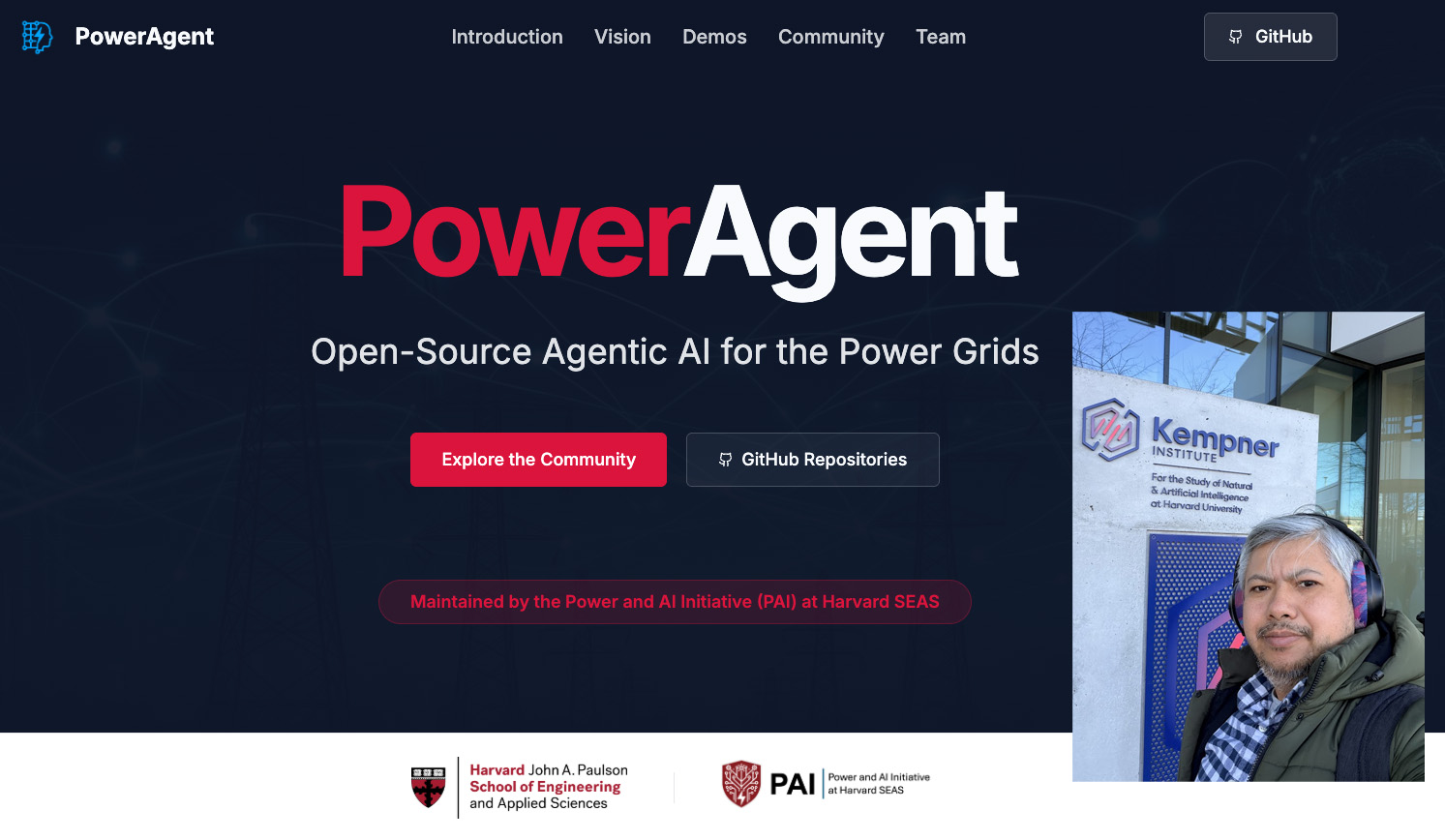
Last week I had the privilege of participating in GridFM at Harvard. The workshop brings together researchers and practitioners who are serious about how machine learning and foundation models can support a power system that is only getting more complex.
Momentum, not hesitation
One of the things that surprised me most was how far along both industry and academia already are in adopting AI—including agentic AI—for the grid. For such a critical infrastructure sector, I expected more hesitation. Instead, I saw a community actively exploring how these technologies can help transform planning, analysis, and eventually operations.
Given the ever-increasing complexity of the grid—more renewables, more distributed resources, more data, more coordination across time horizons—it may simply be that the industry has no real option but to move in this direction. The official agenda reflected that momentum, with sessions on agentic AI, industry deployment, grid operations, and AI-enabled planning.
The "Control Room of the Future"
It was also a privilege to visit Harvard's "Control Room of the Future" concept and see how researchers and practitioners are imagining AI-enabled grid workflows. Some of this remains forward-looking by nature—full operational deployment is never instantaneous—but it was clear that AI is already being taken seriously as a practical tool for planning and decision support today, not only as a research curiosity.
Agentic AI, collaborations, and LLM-connected tooling
The program included work on agentic AI for the power grid, including a Harvard–ISO New England collaboration. Alongside that, tools such as PowerMCP and PowerSkills illustrate a broader trend: connecting power-system capabilities and domain knowledge to LLM-based workflows so that analysis and orchestration can meet engineers where they already work.
Open foundation models and a possible industry shift
Another impression I left with is that open-source foundation models developed specifically for the grid may eventually rival—and in some workflows surpass traditional closed, proprietary simulation environments such as PSS®E. If that trajectory holds, it would represent a major shift for how planning and analysis are done, who can participate, and how quickly new ideas can be tested.
RenAi: making these ideas more accessible
At RenAi, we are working to bring developments like these into a more accessible format so that engineers and innovators can try them for themselves: AI agents for generative hardware design. The goal is not to replace domain expertise, but to lower the friction between imagination, physics, and iteration—especially as the ecosystem around grid AI continues to mature.
Exciting times ahead.
#GridFM #PowerSystems #ElectricGrid #EnergyAI #AgenticAI #FoundationModels #GridPlanning #CriticalInfrastructure #OpenSourceAI #GenerativeAI #DigitalTwin #RenAi #EngineeringAI #Harvard